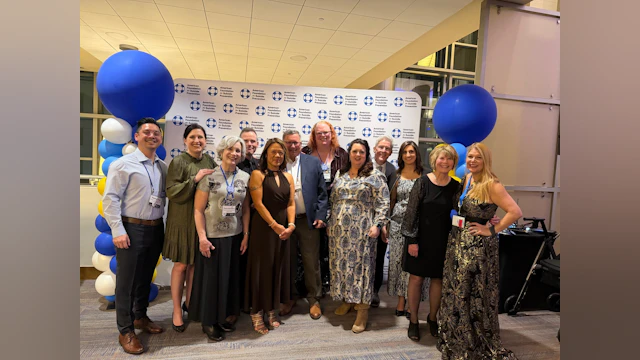
Each January, something pretty remarkable happens. Volunteers for the American Foundation for Suicide Prevention from local chapters across the country pack their bags and travel to one central location, not just to attend a conference, but to come together as a community. We gather to celebrate the work happening in our chapters, to learn about new programs and resources, and to reconnect with why we do this work in the first place.
And each of us arrives carrying our own story.
Some of us are here because we’ve lost someone we love to suicide. Others come with their own lived experience. Some arrive because they support someone at risk, or otherwise feel deeply called to suicide prevention work, even if they can’t quite explain why. Different paths, same purpose. That shared purpose is what makes the AFSP Chapter Leadership Conference so powerful.
The theme for 2026, The Power of Community, feels especially timely. In a society that often feels fractured and disconnected, this conference was a reminder that suicide prevention is collective work. It’s relational. It’s human. And it works best when we do it together.
The weekend unfolded through plenary sessions, breakout learning, self-care, social connection, and celebration.
Plenary Sessions: Grounding Us in Purpose and Possibility
CEO Bob Gebbia opened the conference by reflecting on AFSP’s 39-year history, reminding us that suicide was not even recognized as a public health crisis until the late 1990s. That same era marked the beginning of community-powered momentum, when volunteers first saw the enormous potential of coming together. Advocacy followed in 2010, expanding AFSP’s reach and impact.
Bob also shared a clear vision for the future: deeper volunteer engagement across all communities, sustained revenue growth enabling us to continue our mission, measurable impact, scalable programs, effective policy advancement, continued research investment, stronger chapter capacity, and ultimately reducing suicide in America. It was ambitious, hopeful, and rooted in partnership.
That theme of partnership carried into the Town Hall, featuring Bob, National Board Chair Ray Paul, and Vice Chair Lisa Riley. Lisa spoke about her journey as a volunteer since 2004 and named what she called the “secret sauce” of AFSP: the partnership between staff and volunteers. Ray emphasized the importance of engaging young people as we look ahead. Together, they painted a future that depends on connection across generations and roles.
One plenary that sparked a lot of conversation focused on the risks and benefits of generative AI in suicide prevention. While AI holds promise by expanding reach, supporting health equity, and reducing administrative burden, it also raises serious ethical and safety concerns. The key takeaway was clear: suicide prevention is inherently relational. Technology can support the work, but it can never replace human connection.
Jennifer Bennett’s keynote, Where Passion Meets Purpose, spoke directly to volunteers. She reminded us that engagement looks different for everyone, that sometimes roles evolve and that clear expectations matter. Her message about transformational leadership reinforced that strong communities are built with care, clarity, and respect.
Chief Medical Officer Dr. Christine Moutier expanded the conversation by focusing on collaboration, vulnerability, and what she described as “positive social contagion.” In other words: as humans, we mimic one another often unconsciously. AFSP intentionally harnesses that tendency to spread protective behaviors, help-seeking, science and most importantly hope. She also noted that nearly everything we know about suicide today has been touched by AFSP-funded research, totaling almost $100 million invested.
We also heard powerful examples of AFSP acting as a catalyst for change from early investments in youth suicide prevention research to leadership in lethal means safety, bridge barriers, and responsible storytelling in popular culture. Across all these sessions, the message was consistent: impact grows when we connect research, policy, lived experience, and community action.
Breakouts, Connection, and Care
Breakout sessions allowed participants to dive deeper into specific areas such as board leadership, walk planning, impact-driven communication, an upcoming program focused on the LGBTQ+ community, support for loss survivors, and more. These smaller spaces fostered learning, problem-solving, and shared wisdom across chapters.
Connection continued outside the sessions. A get-acquainted lunch brought together volunteers from different chapters to talk about everything from walks to loss to hope. One evening was dedicated to dinner with our own chapters for a chance to reflect and recharge together.
Celebration was woven throughout the weekend, especially during the awards luncheon and Chapter Awards Banquet. From Chapter of the Year to programming, fundraising, research connection, and social media, the awards highlighted what’s possible when communities are empowered.
And importantly, the conference made space for self-care. Morning yoga and group walks, guided imagery, art activities, and group reflection reminded us that caring for ourselves is not separate from this work but that it’s essential to sustaining it.
Leaving Connected
I left the conference feeling grounded, energized, and deeply connected to people, to purpose, and to possibility. The Power of Community isn’t just a theme; it’s the foundation of suicide prevention. It’s what keeps us showing up, year after year, even when the work is hard. As Mike Lamma, Executive Vice President and Chief Operating Officer, reminded us as the conference came to a close, “We are in the business of hope.”
While we returned to different homes and communities at the end of the weekend, we remain connected by a shared commitment to suicide prevention. We leave not as individuals, but as a powerful, united community, ready to carry hope back to our chapters, our neighborhoods, and our country.
People often ask whether a suicide prevention conference is sad or depressing. In reality, it is the exact opposite. It is filled with love, laughter, community, support, and connection. It is a space where stories are honored, science is celebrated, and hope is not only talked about but actively built, together.
Learn how you can become an AFSP volunteer, and help save lives.